
Project Management & Execution
Project Management Does Not Have to Be Complicated
Good project management should make work feel simpler, not heavier. Organization, visibility, and the right automation protect people's attention.
By Jeremy Vetter · 7 min read
Somewhere along the way, project management became associated with complexity.
More meetings. More spreadsheets. More software. More status reports.
More people asking other people when something will be finished.
It does not have to work that way.
Good project management should actually make work feel less complicated.
At its core, project management is about creating enough clarity that people can answer a few important questions:
What are we trying to accomplish?
What needs to happen next?
Who owns it?
When does it need to happen?
Is anything getting in the way?
Everything else should support those answers.
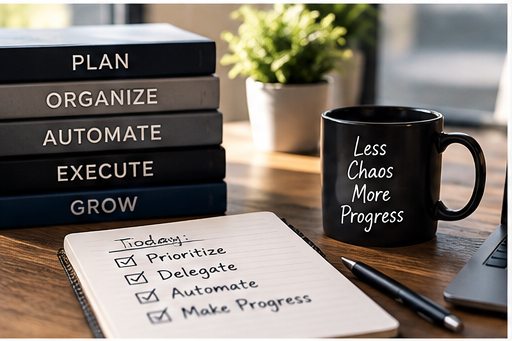
Organization reduces mental load.
One of the most expensive forms of inefficiency is not always visible on a financial statement.
It is the amount of mental energy people spend remembering things.
- “Did anyone follow up on that?”
- “Which version is final?”
- “Who was handling this?”
- “Wasn't that supposed to happen yesterday?”
- “Where did we put that document?”
When important information exists primarily in people's heads, email chains, chat messages, notebooks, and disconnected spreadsheets, everyone becomes part-time project-management software.
A better system gets information out of people's heads and into a dependable workflow.
Visibility changes everything.
A healthy project should not require a meeting just to determine what is happening.
Teams should be able to see:
- current priorities
- ownership
- upcoming deadlines
- outstanding decisions
- dependencies
- risks
- project status
That does not mean building a massive dashboard.
Sometimes a well-designed task board and a few clear rules are enough.
The objective is not to document everything.
It is to make the important things visible.
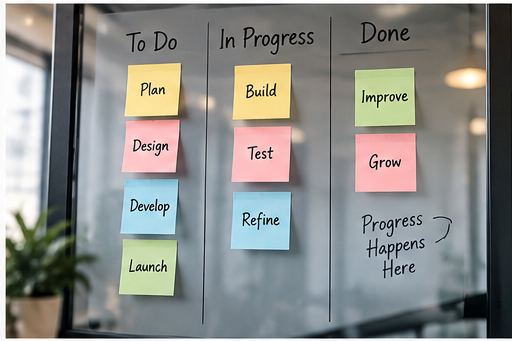
Automation should remove repetitive work — not human judgment.
Automation can be incredibly useful in project management.
- A task is completed and the next owner is notified.
- A deadline approaches and the appropriate reminder is sent.
- A form submission creates a project record automatically.
- Information entered once flows into the places it is actually needed.
- A status changes and stakeholders receive the right update.
Those are great uses of automation.
But automation should not make a bad process run faster.
Before automating something, ask:
Why are we doing this step?
Does someone actually need it?
Could it be eliminated?
Could it be simplified?
Then automate what remains.
Better workflows create time for better thinking.
This is the part organizations sometimes overlook.
Efficiency is not valuable merely because people can complete more tasks.
It is valuable because attention is limited.
Every hour spent locating information, manually transferring data, chasing an update, or sitting through an unnecessary status meeting is an hour unavailable for:
- strategic planning
- problem solving
- customer relationships
- creative thinking
- leadership
- innovation
The best workflow does not simply move work faster.
It protects people's ability to think.
Five signs your project system needs attention
1. Nobody knows where the source of truth is.
If three spreadsheets, two email threads, and someone's handwritten notebook all contain different versions of the project, that is a problem.
2. Ownership is unclear.
Tasks should not belong to “the team.”
Important work needs a clear owner.
3. Problems become visible only after deadlines are missed.
Good project visibility identifies risk before it becomes failure.
4. Meetings exist primarily to exchange status updates.
If information could have been visible asynchronously, the meeting should be reserved for discussion, decisions, and problem solving.
5. The process depends on one person remembering everything.
If a critical workflow collapses when one person goes on vacation, the system needs work.
Start by simplifying, not adding.
Before purchasing another platform, map how the work happens today.
- Where does a project begin?
- Where does information enter?
- Who touches it?
- Where do decisions occur?
- What gets duplicated?
- Where does work regularly stall?
- What requires someone to remember something manually?
You will often discover that the opportunity is not another tool.
It is a better process.
Technology becomes much more powerful after that process makes sense.
Project management should create confidence.
A well-run project does not mean nothing ever changes.
Projects change constantly.
The difference is that people understand what is happening, why it is happening, and what comes next.
That reduces stress. It improves accountability.
And it gives leaders more room to lead instead of constantly chasing the work.
If your projects feel harder than they should…
Vetter Ventures helps organizations examine the systems surrounding their work — from project structure, workflow design, process optimization, AI, and automation.
The goal is not more project management.
It is better execution with less unnecessary friction.
Next step
Contact Jeremy.
Call or text 803.446.6060 for a short, straightforward conversation — no sales presentation. Prefer to write? Send a message and Jeremy will follow up personally.