
Marketing Content & Creative Assets
Sharpen the Message Before You Turn Up the Volume
More marketing is not always the answer. Clear marketing content closes the information gap and improves conversion from attention you already have.
By Jeremy Vetter · 7 min read

More marketing is not always the answer.
Sometimes the bigger problem is that people do not immediately understand what you are marketing.
You can increase ad spend. Post more frequently. Send more emails. Print another brochure. Build another landing page.
But if the underlying message is unclear, you are often just sending more people toward confusion.
Before turning up the volume, sharpen the message.

Customers do not know your business the way you do.
Business owners have an enormous amount of context.
You understand why the service exists. You know the differences between your options. You understand your terminology. You know why customers choose you.
Your prospective customer usually does not.
They are scanning a webpage, brochure, social post, proposal, or Google profile trying to answer:
Is this for me?
Do I understand what they offer?
Can they solve my problem?
Do they seem credible?
What happens next?
Good customer-facing content closes that information gap.
Clear beats clever.
One of the easiest marketing mistakes is trying so hard to sound impressive that the message becomes less understandable.
Compare:
“Transformative solutions engineered to elevate your organizational ecosystem.”
with:
“We help businesses eliminate inefficient workflows and build systems that are easier to manage.”
The first sounds important.
The second tells me something.
Professional communication does not need to be boring, but clarity should win every time.
Your customer-facing assets are trust signals.
Marketing content includes far more than advertisements.
It is every piece of information customers encounter while deciding whether to trust you. That may include:
- your website
- proposals
- service guides
- social graphics
- presentations
- brochures
- downloadable resources
- email follow-ups
- Google Business Profile
- booking pages
- sales materials
- onboarding documents
Individually, each piece may seem minor.
Collectively, they form your brand experience.
When those assets look and sound like they belong to seven different businesses, customers notice — even if they cannot explain what feels wrong.
Quality means useful, not merely attractive.
Beautiful design is valuable.
But attractive content that does not answer customer questions is decoration.
Strong marketing assets should help someone do something.
- Understand a service.
- Compare options.
- Prepare for an appointment.
- Evaluate whether they are a good fit.
- Make a decision.
- Take the next step.
A polished PDF that genuinely helps a prospective client can build more trust than ten promotional posts saying how great the company is.
Useful content demonstrates expertise instead of merely claiming it.
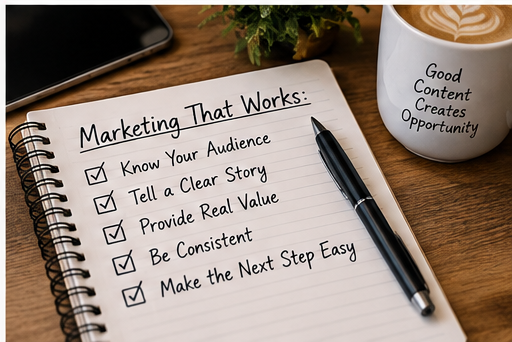
Start with the message hierarchy.
Before designing the graphic or writing the campaign, determine what matters most.
A simple hierarchy often works:
1. The problem
What is happening in the customer's world?
2. The outcome
What do they want to be different?
3. The solution
How do you help?
4. The reason to trust you
What makes the business credible or appropriate?
5. The next step
What should they do now?
That structure works on websites, advertisements, brochures, presentations, emails, and landing pages because it mirrors the questions customers already have.
Consistency makes businesses look established.
Consistency does not mean every asset must look identical.
It means customers should recognize the same organization across every interaction.
Your:
- typography
- colors
- imagery
- tone
- terminology
- offers
- calls to action
should feel related.
That repetition builds familiarity.
And familiarity helps build trust.
Audit your message from the outside.
Try this exercise. Gather five customer-facing assets:
- Your homepage.
- Google Business Profile.
- A recent social post.
- A proposal or brochure.
- A sales email.
Then ask:
Would someone unfamiliar with the business describe what we do the same way after seeing each one?
If the answer is no, that is useful information.
You may not have a marketing-volume problem.
You may have a message consistency problem.
Better content can improve conversion without increasing traffic.
This is one of the reasons messaging work can be so valuable.
Imagine 1,000 people already visit your website.
You could spend money trying to attract another 1,000.
Or you could improve what happens when the first 1,000 arrive.
- A clearer headline.
- Better explanation of the service.
- Stronger calls to action.
- More useful photography.
- A better FAQ.
- A valuable downloadable resource.
- A simpler booking experience.
Improving conversion from existing attention is often worth investigating before buying more attention.
Marketing should make the decision easier.
Great content does not pressure people.
It reduces uncertainty.
It helps the right customer recognize:
“This is what I need.”
That is what conversion-focused marketing should accomplish.
Not manipulation. Not noise.
Clarity. Credibility. Usefulness.
Before creating more content, ask whether the current content is doing its job.
Vetter Ventures helps businesses strengthen customer-facing messaging, digital experiences, marketing assets, and conversion paths so the quality of the presentation better reflects the quality of the business behind it.
If your company is doing excellent work but the message is not communicating it clearly, that is a problem worth fixing.
Next step
Contact Jeremy.
Call or text 803.446.6060 for a short, straightforward conversation — no sales presentation. Prefer to write? Send a message and Jeremy will follow up personally.